How worried should the industry be about Vistry?
Housebuilding industry poster-child Vistry has been charting an aggressive growth course despite a tricky market over the last two years. Joey Gardiner asks why it has now lost half its value after two profit warnings in two months
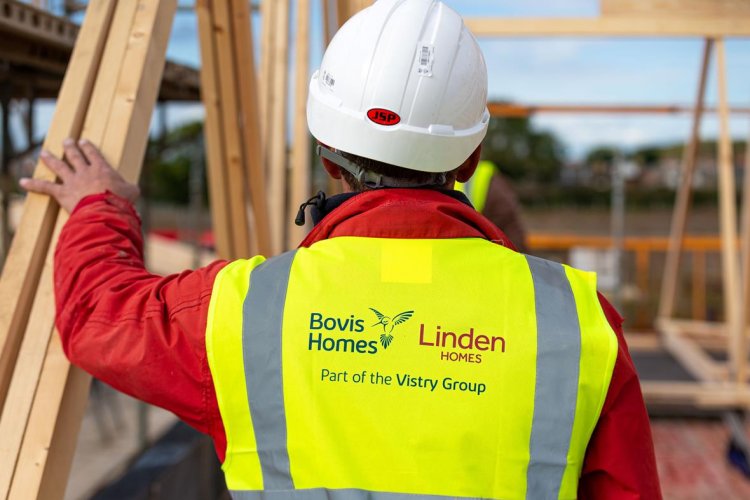
For the past year, it is fair to say that partnerships housebuilder Vistry has been the toast of the housebuilding sector. While others have been reducing their output, Vistry has grown rapidly, saying in September that it had become the UK’s biggest residential developer – with its eyes on delivering 30,000 to 40,000 homes a year in the long term.
Its focus on the vital affordable housing space means that it has also made itself a key part of the government’s 1.5 million homes ambition. No surprise then that its stock market value outperformed other housebuilders this year – by an average of 43% to October – hitting over £4.5bn at peak.
But, on 8 October, events took a turn for the worse. More than £1bn was wiped off the value of the company in a single day following a profit warning related to what it initially said were £115m of “understated” cost projections on its projects. And last Friday, things got even worse, as the business revealed a further £50m profit warning and said it was reviewing growth prospects for the years ahead. The firm’s chief executive Greg Fitzgerald admitted the news was “very unfortunate [and] upsetting”, and the market seemed to agree – Vistry ended the day with shares down nearly 20%, and the company overall worth less than half what it was just two months ago.
However, the firm, which sells most of the homes it builds to housing association, local authority and build to rent clients under “partnership” deals, said on Friday that it continued to believe that the problem is largely related to just one part of the business.
It said an in-depth review of the issue, commissioned in October, had confirmed its expectation that the cost projecting issue was not systemic across the rest of the business. “Critically, we found no systemic issues outside of the South Division,” Fitzgerald said on the analyst call on Friday. “That’s the big takeaway.”
The continuing roster of major project wins announced since the initial October profit warning – such as Bromford, for 700 homes; Hinckley, Leicestershire for 475; and Solihull Council for around 200 – certainly indicates business as usual. However, the Friday update did also point to other issues which could affect future performance, such as newly rising build costs overall, the impact of Labour’s national insurance changes, escalating building safety costs, and a weaker than expected market. Certainly, the scale of the drop in the firm’s value suggests there are many who have their doubts. The profit warning seems to be a vector which has allowed questions about the business’s rapid transformation, its business model and its charismatic CEO and chair to resurface.
A problem in the southern division
Vistry said on 8 October that the “total full-life cost projections” to complete some projects had been understated by around 10% of “total build costs”. It said the £115m problem was limited to just nine schemes – out of more than 300 across the business – and to just its southern division (one of six).
It immediately commissioned an independent review into the issue, conducted by Vistry’s independent non-executive director, and former Laing O’Rourke finance director, Rowan Baker, which reported at the scheduled trading update last Friday.
In broad terms, while this review uncovered an extra £50m of costs, it ultimately endorsed Vistry’s belief that the problem regarding cost projections has not been systemic across the business (see ’What Vistry has said’, below). Speaking to analysts, Fitzgerald, who, according to the Times last Friday, had gone to the board to offer his resignation in the light of the profit warning, said the issues had been confined to jobs in the former housebuilding parts of the business – not jobs running the new “partnerships” model – and all in the southern division, where management was being taken in hand. “Management capability in certain areas has been an issue,” he admitted, “and non-compliance with our processes and a poor divisional culture. [But] That all relates to the South division.
“We are extremely confident that we have now uncovered, in the last five weeks, the full extent of the issues, and there will be no more adjustments.”
There is also, to date, no evidence that Vistry has financial problems on further jobs, and there are plenty in the sector happy to accept this account of events. Terry Fuller, former Taylor Wimpey executive and Homes England regional director, says the negative reaction has been overdone. “There has been an increase in overall build costs across the industry. Vistry is not alone here. There might have been some very poor decision-making in a division, but all firms go through this.
“If I’m an investor, I’m asking if the cash flow is still good – and the answer’s ‘yes’. You could actually argue the timing of Vistry’s expansion in terms of the wider market now picking up is great.”
Moreover, while the warning will impact profitability by £105m this year, Vistry has made clear that it is sticking to a series of previously announced financial goals, including a £130m share buyback scheme, £1bn of capital back to shareholders and £800m adjusted profit.
Displaying his confidence in the business, Fitzgerald immediately bought £200,000 of stock after 8 October – presumably in the expectation of a price recovery.
Greg Campbell, partner at consultant Campbell Tickell, which advises housing associations on development deals, speaking after the first profit warning, said he had confidence that the business will stay on track. “The response suggests they’ve had an issue and they’re dealing with it,” he said.
“There’s a lot of talk out in the market, but how much is just stirred up by competitors with their noses put out of joint?”
Another industry figure close to the firm, who declined to be named, agreed. “Vistry is a disruptor. You shouldn’t be surprised if those that are happy with the orthodoxy are lining up to criticise it.”
So, given all this, why the extreme reaction by the City? Initially, after 8 October, investors will have been worried that the profit warning was the beginning, not the end of problems. While the reaction to the review will have offered some reassurance that problems are not systemic, it also flagged a lowering of expectations in the medium term.
What's Your Reaction?